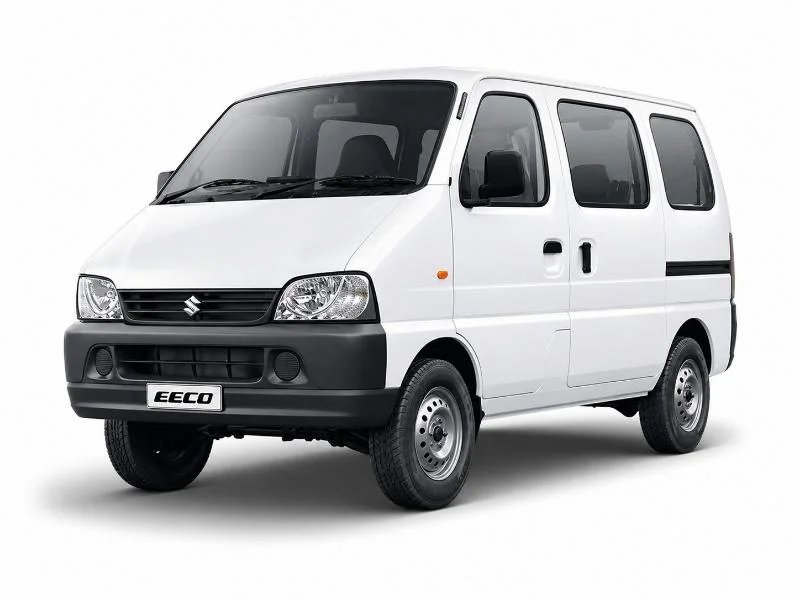
AIS-024 approved sequential CNG kit installation in Maruti Suzuki Eeco — 1.2L K12M engine, 5-speed manual, with the largest usable cargo space of any Maruti after conversion.
CNG Kit Installation in Maruti Suzuki Eeco
The Maruti Suzuki Eeco is not a lifestyle car. It is India's most important commercial vehicle — the backbone of last-mile delivery, courier fleets, small cargo operators, and passenger transport in every city, town and village in the country. It is cheap to buy, cheap to run, absurdly practical, and almost indestructible. And for CNG conversion, it is the single best model in Maruti's entire range.
Here is why. The Eeco uses the proven 1.2L K12M four-cylinder engine — a simple, reliable unit that has powered hundreds of thousands of commercial vehicles. Its kerb weight is roughly 950–1,000 kg, which is heavier than Maruti's 1.0L hatchbacks, but the engine is bigger and torquier, so the conversion handles loaded work comfortably. And most importantly, the Eeco has a 540-litre boot — the largest in the entire Maruti range. Where an Alto K10 has to give up almost its entire boot to fit a cylinder, the Eeco swallows a 60L cylinder and still has roughly 300 litres of cargo space left over.
Maruti sells the Eeco as a factory S-CNG in selected trims, but aftermarket CNG kit installation in Maruti Suzuki Eeco gives you the choice of a larger 60L cylinder, a premium Italian kit, and the flexibility to convert any Eeco variant — 5-seater or 7-seater, and every trim from the base to the top. At Cars Energy, we have converted hundreds of Eecos for commercial operators, and we treat it as the workhorse it is. This page covers everything: engine compatibility, kit selection, real-world mileage, the cargo-space advantage, 5-seater and 7-seater considerations, AIS-024 documentation, RTO endorsement, and the seat-capacity amendment that applies if you permanently remove the third row.
Request a Quote for Eeco CNG Kit Installation →
Maruti Suzuki Eeco — CNG Suitability Snapshot
Table of Contents
- 1. Why the Eeco Is the Best Maruti for Commercial CNG
- 2. Eeco Generations, Engines & Compatibility
- 3. Factory S-CNG vs Aftermarket CNG
- 4. Which CNG Kit Is Right for Your Eeco?
- 5. Performance & Real-World Mileage
- 6. The Cargo-Space Advantage (540L Boot)
- 7. 5-Seater vs 7-Seater Variants & Seat Amendment
- 8. Installation Process Step-by-Step
- 9. Complete Cost Breakdown (2026)
- 10. RTO Endorsement & Commercial Vehicle Rules
- 11. ECU Tuning for the K12M Engine
- 12. Commercial Use Notes & Fleet Considerations
- 13. Maintenance & AMC Schedule
- 14. Warranty & Insurance Impact
- 15. Common Mistakes to Avoid
- 16. Eeco vs Other Marutis for CNG
- 17. Running Cost & Payback Calculation
- 18. Pros & Cons of Eeco CNG
- 19. Frequently Asked Questions
- 20. Book Your Eeco CNG Installation
1. Why the Eeco Is the Best Maruti for Commercial CNG Kit Installation in Maruti Suzuki
Every Maruti converts to CNG differently. Some are great for city commuters (Alto K10, S-Presso, Celerio), some are great for families (Ertiga, XL6), and some are great for high-mileage private use (Swift, Dzire). But only the Eeco is engineered, from the ground up, to be a commercial workhorse that happens to convert to CNG exceptionally well. Here is why CNG kit installation in Maruti Suzuki Eeco is a business decision, not just a fuel upgrade.
- The 540-litre boot is the largest in Maruti's entire range: This is the single most important point on this page. A 60L cylinder in the Eeco still leaves roughly 300 litres of usable cargo space — more than the entire boot of a Swift (268L). No other Maruti offers this combination of cargo capacity and CNG running cost. For last-mile delivery, courier fleets, small cargo operators and any business that needs to move goods cheaply, this is a decisive advantage.
- The 1.2L K12M four-cylinder engine has the torque for loaded work: 104 Nm is more than enough to move a fully loaded Eeco with a cylinder on board. This is a bigger, torquier engine than the 1.0L three-cylinder units in the Alto K10 and S-Presso, and it handles commercial duty — stop-start delivery, full loads, frequent loading and unloading — far more gracefully than a small hatchback engine would.
- Simple, bulletproof engine design: The K12M is an older-generation, single-injector 4-cylinder engine. It is simpler than the DualJet engines in newer Marutis and has a proven track record in commercial use over hundreds of thousands of vehicles. It tolerates gas operation with minimal fuss and is cheap to maintain.
- Lowest maintenance cost of any Maruti commercial vehicle: Parts are cheap, service networks are everywhere, and the K12M is one of the most widely serviced engines in India. For a commercial operator, this matters as much as the fuel cost.
- Factory S-CNG precedent: Maruti sells the Eeco S-CNG in selected trims, which means mounting points, wiring routes and cylinder brackets are proven. This substantially reduces installation risk and makes the conversion faster.
- Rugged, simple construction: The Eeco is built to work. Its ladder-frame-adjacent construction, high ground clearance and simple suspension handle a cylinder with minimal impact on reliability or longevity.
- Strong resale value in the commercial market: A properly documented, RTO-endorsed CNG Eeco sells quickly in the used commercial vehicle market, often at a premium over an equivalent petrol unit. For a fleet operator, this is the final piece of the total-cost-of-ownership calculation.
2. Eeco Generations, Engines & CNG Compatibility
The Eeco has been sold in India with the same basic 1.2L engine since its launch, with incremental updates. The exact CNG kit installation in Maruti Suzuki Eeco approach is straightforward on all of them.
Current Eeco (2010–Present, facelifted multiple times)
- 1.2L K12M: 4-cylinder, 80 PS / 104 Nm, single-injector (non-DualJet). This is the engine used across the entire Eeco range and the focus of this guide. It requires a standard sequential MPI kit with a high-flow reducer. It is one of the simplest, most reliable 4-cylinder engines in India to convert.
- 5-seater and 7-seater variants: Both use the same K12M engine. The conversion process is identical, but the 7-seater may require a seat-capacity amendment if the third row is permanently removed (see Section 7).
- CNG variant (factory S-CNG): Available in selected trims. If you own one, only service and AMC apply — you do not need a fresh conversion.
| Eeco Model Year | Engine | Displacement | Power / Torque | CNG Suitability | Notes |
|---|---|---|---|---|---|
| 2010 – Present | 1.2L K12M | 1197 cc, 4-cyl | 80 PS / 104 Nm | ★★★★★ | Single engine across the range; factory S-CNG available on selected trims |
| 5-seater variant | 1.2L K12M | 1197 cc, 4-cyl | 80 PS / 104 Nm | ★★★★★ | No seat amendment needed; best for cargo use |
| 7-seater variant | 1.2L K12M | 1197 cc, 4-cyl | 80 PS / 104 Nm | ★★★★★ | Seat amendment (7 to 5) required if third row permanently removed; popular for passenger transport |
The Eeco has never been offered with a diesel engine in India. It has also never been offered with an automatic transmission — all Eecos are 5-speed manual. This actually makes the CNG conversion simpler, because there is no AGS or torque-converter calibration to worry about.
3. Factory S-CNG vs Aftermarket CNG Kit Installation in Maruti Suzuki Eeco
Maruti sells the Eeco S-CNG in selected trims. Should you buy the factory version or go for aftermarket CNG kit installation in Maruti Suzuki Eeco? Here is an honest comparison.
| Parameter | Factory Eeco S-CNG | Aftermarket CNG Kit Installation |
|---|---|---|
| Available Variants | Selected trims only | Any Eeco variant — 5-seater or 7-seater, any trim |
| Cylinder Size | Typically smaller factory fitment | 55L or 60L — your choice, and the Eeco has room for the biggest |
| Kit Brand Choice | Maruti-supplied only | Lovato, BRC, Tomasetto, Landi Renzo, OMVL and others |
| Warranty | Full factory warranty retained | Engine/powertrain warranty typically voided |
| Cost Premium | ~₹70,000 – ₹75,000 over equivalent petrol variant | ~₹38,000 – ₹48,000 all-inclusive |
| ECU Tuning | Pre-calibrated by Maruti | Custom laptop calibration, better suited to loaded commercial work |
| RTO Endorsement | Comes pre-endorsed | Must be applied for separately (we assist, including seat amendment) |
| Best For | Private buyers prioritising warranty and zero paperwork | Commercial operators, fleet buyers, 7-seater owners, and anyone wanting a 60L cylinder |
Almost all Eecos we convert are commercial vehicles. For commercial operators, the factory S-CNG is not a realistic option — the higher premium, the fixed cylinder layout, and the fact that many fleet Eecos are bought second-hand and converted later all point to aftermarket. Aftermarket CNG kit installation in Maruti Suzuki Eeco gives a lower upfront cost, a 60L cylinder that fits without compromising cargo space, and full documentation for the RTO including seat-capacity amendment where required.
4. Which CNG Kit Is Right for Your Eeco?
Only a sequential MPI (multi-point injection) kit should be used for CNG kit installation in Maruti Suzuki Eeco. A venturi or open-loop kit has no place on any modern engine — it causes backfiring, check engine lights, power loss and RTO rejection.
Recommended Kit Specification for the K12M
- Type: Sequential gas injection with dedicated CNG ECU
- OBD-II compatibility: Mandatory for BS6 vehicles and required for AIS-024 compliance
- Reducer: High-flow unit — the Eeco is heavier than a hatchback and often carries a full commercial load, so an undersized reducer will lean out at high RPM and under load
- Injectors: Matched to the 1.2L 4-cylinder engine; a kit meant for a 1.0L three-cylinder will cause lean running
- Certification: AIS-024 (and AIS-028 where applicable) type approval
- Safety: Excess-flow valve, pressure relief device, manual shut-off valve, and a PESO-certified cylinder with a valid hydro-test
Popular Kit Brands for the Eeco
| Brand | Origin | Best Suited For | Indicative Price Band |
|---|---|---|---|
| Lovato | Italy | Premium conversions; excellent refinement under commercial load | ₹42,000 – ₹48,000 |
| BRC | Italy | Best-in-class ECU tuning for loaded commercial work | ₹43,000 – ₹48,000 |
| Tomasetto Achille | Italy | Great value-for-money sequential system for fleet use | ₹39,000 – ₹43,000 |
| Landi Renzo / OMVL | Italy | Proven reliability, widely serviced in commercial fleets | ₹40,000 – ₹45,000 |
| Reputed Indian brands | India | Budget fleet conversions, easy spare availability | ₹38,000 – ₹41,000 |
5. Performance & Real-World Mileage After Conversion
Maruti publishes a claimed figure of around 26.11 km/kg for the factory Eeco S-CNG. Real-world numbers after aftermarket CNG kit installation in Maruti Suzuki Eeco depend heavily on how much load is on board.
| Eeco Configuration | City (km/kg) | Highway (km/kg) | City, AC + Full Cargo | Range on 60L Cylinder |
|---|---|---|---|---|
| 5-seater, light load | 24–25 | 27–28 | 21–23 | ~340–380 km |
| 5-seater, full commercial load | 22–23 | 26–27 | 20–22 | ~310–350 km |
| 7-seater, 5 passengers + luggage | 23–24 | 26–27 | 20–22 | ~320–360 km |
| 7-seater, full 7 passengers + AC | 21–22 | 25–26 | 19–21 | ~300–330 km |
Figures assume a correctly calibrated sequential kit with a high-flow reducer, a 60L water-capacity cylinder (≈ 48L usable gas, holding roughly 10–11 kg of CNG), normal tyre pressures and mixed city/highway driving. A fully loaded commercial Eeco with the AC on all the way will sit at the lower end.
What About Power Loss?
With a properly tuned sequential kit, expect an 8–12% reduction in peak power and torque on gas. In practice, this means:
- City driving with a light load: Barely noticeable. The K12M engine has enough torque that the Eeco pulls cleanly from low speed in second and third gear — exactly what you need for stop-start delivery work.
- Highway with a full load: Noticeable on inclines and during overtakes. You will use a lower gear than you would on petrol. This is normal for any CNG conversion on a loaded commercial van.
- Start-stop delivery work: Well-calibrated gas operation feels smooth and predictable. A poorly calibrated kit will feel sluggish when pulling away from a stop with a full load — which is why calibration matters more on commercial Eecos than on private cars.
- Long-distance commercial work: The Eeco's 60L cylinder plus its original petrol tank gives a combined range that comfortably exceeds 700 km — ideal for intercity courier and light freight routes.
Ask your installer to set the CNG ECU to blend back to petrol above roughly 4,000 RPM or when manifold pressure crosses a set threshold. On a fully loaded Eeco, this preserves overtaking and incline-climbing ability without meaningfully affecting your monthly fuel bill, because the engine spends very little time in that zone during normal commercial duty.
6. The Cargo-Space Advantage — Why the Eeco Wins on 540 Litres
This is where CNG kit installation in Maruti Suzuki Eeco differs from every other Maruti page on this site. On most cars, the cylinder takes a meaningful bite out of the boot, and you have to choose between range and practicality. On the Eeco, you do not. The 540-litre boot is so large that a 60L cylinder still leaves roughly 300 litres of usable cargo space — more than an entire Swift's boot.
Eeco Petrol Boot Space for Reference
- 540 litres with all rows up (5-seater: rear bench in place)
- ~1,000+ litres with the rear bench folded (5-seater, cargo mode)
- 7-seater: reduced with the third row up, but still substantially larger than any hatchback
Layout A — 60L Cylinder (Recommended — Still Leaves ~300L of Cargo Space)
- Best range: roughly 340–380 km on gas with a light load
- Still leaves roughly 300 litres of usable cargo space — more than an entire Swift boot
- This is the layout we recommend for almost every Eeco owner
- For last-mile delivery, this is more than enough space for a typical daily load
- The Eeco's rugged suspension and high ground clearance handle the cylinder weight without drama
Layout B — 55L Cylinder (If You Want a Lower Load Floor)
- Slightly less range than the 60L (roughly 310–350 km)
- Sits slightly lower, so the load floor is a little more usable for tall items
- A good choice if you regularly carry tall or awkward cargo and can live with slightly shorter range
Practical Tips for the Eeco Cargo Area After CNG Installation
- Ask for a custom load floor or false floor over the cylinder. The Eeco's flat cargo area is one of its biggest advantages, and a proper load floor keeps it usable for goods while protecting the cylinder.
- Insist on a custom bracket rather than a generic one — the cargo floor has specific reinforcement points and a correctly designed bracket spreads the load properly, especially under heavy cargo.
- If the Eeco does commercial delivery work, plan the cylinder position around your loading pattern. Most operators fit the cylinder forward in the cargo area, leaving the rear-most space for goods that need easy access at the door.
- Keep the cylinder valve and manual shut-off accessible from the rear hatch at all times.
- Never stack heavy items directly against the cylinder valve or the high-pressure line — especially important in a cargo vehicle.
7. 5-Seater vs 7-Seater Variants & the Seat-Capacity Amendment
The Eeco is sold as both a 5-seater and a 7-seater. The CNG conversion process is identical, but the legal paperwork differs — and this catches people out.
5-Seater Eeco
- No seat-capacity amendment needed — the rear bench stays in place, and the cylinder fits behind it or in the cargo area without affecting seating capacity
- This is the most common variant for cargo and last-mile delivery use
- Simplest paperwork: only the fuel-type endorsement on the RC is required
- Best cargo space retention of any Maruti after conversion
7-Seater Eeco
- If the third row is permanently removed or folded flat to accommodate the cylinder, the seating capacity on the RC must be amended from 7 to 5
- For commercial vehicles, the permit and fitness certificate must also be updated
- If you genuinely need 7 seats and carry no luggage, a smaller cylinder in a custom low-profile bracket can sometimes preserve third-row access — but this requires careful planning and is not always possible
- Most 7-seater Eeco owners choose to keep the 7-seat configuration and fit a smaller cylinder, or accept the 7-to-5 amendment and use the space for cargo
8. Installation Process Step-by-Step
A professional CNG kit installation in Maruti Suzuki Eeco takes about 6 to 7 hours at our workshop, including the custom cargo-area bracket and the additional care needed for commercial documentation. Here is exactly what happens.
Step 1 — Pre-Installation Health Check & Layout Consultation (≈ 1 hour)
- OBD-II scan for existing fault codes
- Compression test and spark plug inspection
- Check engine mounts, coolant level, battery health and rear suspension condition
- Confirm 5-seater or 7-seater variant
- If 7-seater: confirm whether the third row will be kept or permanently removed, and whether a seat-capacity amendment is needed
- Confirm cylinder size (55L or 60L) based on cargo use
Step 2 — Cylinder Bracket Fabrication & Mounting (≈ 2 hours)
- Fabricate a custom bracket for the Eeco cargo floor
- Bolt to the chassis mounting points with anti-vibration padding
- Install the cylinder with proper torque and verify load distribution
- Route the high-pressure stainless steel line along the underbody, keeping it well protected
- Install the filling valve in a protected position near the fuel filler
Step 3 — Reducer, Injectors & Plumbing (≈ 1.5 hours)
- Mount the high-flow reducer/vaporiser in the engine bay
- Tap into the engine coolant circuit to warm the reducer
- Drill and fit the gas injector rail onto the intake manifold
- Connect the low-pressure gas line from reducer to injector rail
Step 4 — Wiring & CNG ECU (≈ 1 hour)
- Mount the CNG ECU in a heat-protected location
- Wire the injector emulator, OBD link and changeover switch
- Install the gas level indicator and changeover switch on the dashboard
- Fuse and protect all electrical circuits properly
Step 5 — Leak Test & Pressurisation (≈ 45 minutes)
- Fill the system with gas and apply soap solution to every joint
- Check the excess-flow valve and pressure relief device operation
- Confirm zero leaks before proceeding
Step 6 — ECU Tuning & Road Test (≈ 1.5 hours)
- Connect a laptop to the CNG ECU and the car's OBD-II port
- Monitor short-term and long-term fuel trims on petrol and gas at idle, part load and full load
- Adjust the injection map for smooth idle, clean cold starts and correct power delivery
- Test with a load — ballast or a full cargo load — not just an empty van
- Verify no check engine light after a mixed 50+ km drive
Step 7 — Documentation Handover
- Installation certificate
- AIS-024 type approval certificate for the kit
- PESO hydro-test certificate for the cylinder
- Guidance on RTO submission, insurance endorsement and — for 7-seater conversions — the seat-capacity amendment
9. Complete Cost Breakdown for CNG Kit Installation in Maruti Suzuki Eeco (2026)
| Component | Details | Indicative Cost |
|---|---|---|
| Sequential CNG Kit (1.2L) | High-flow reducer, 4-cylinder injector rail, CNG ECU, wiring harness, changeover switch | ₹25,000 – ₹32,000 |
| CNG Cylinder (60L) | PESO-certified, with valve and brackets | ₹7,000 – ₹10,000 |
| Custom Cargo Bracket & Load Floor | Cargo-area bracket fabrication, false floor over the cylinder | ₹2,500 – ₹4,500 |
| Installation Labour | Fitment, plumbing, wiring, leak test, road test | ₹5,000 – ₹7,000 |
| ECU Tuning | Laptop calibration with fuel-trim monitoring | Included in most quotes |
| RTO Endorsement Assistance | Documentation, forms, seat-capacity amendment (if required) and follow-up (government fees extra) | ₹2,500 – ₹4,500 |
| Total (Typical) | All-inclusive for a 1.2L Eeco with a standard sequential kit and 60L cylinder | ₹38,000 – ₹48,000 |
Optional Extras
- 55L cylinder instead of 60L: −₹1,000 to −₹2,000
- Premium Italian kit (Lovato/BRC): +₹5,000 – ₹8,000
- Heavy-duty cargo load floor: +₹2,000 – ₹4,000
- Heavy-duty rear helper springs (for permanently loaded commercial use): ₹4,000 – ₹6,000
- Annual Maintenance Contract (AMC): ₹3,500 – ₹5,000 per year
- Commercial documentation package (permit, fitness and seat-capacity coordination): quoted separately
10. RTO Endorsement & Commercial Vehicle Rules
Driving an Eeco after CNG kit installation in Maruti Suzuki Eeco without an updated Registration Certificate is illegal. The RTO must formally endorse the fuel type change on your RC — and for a 7-seater commercial Eeco, there is often a second change to process at the same time.
Documents Required — Private Vehicle (5-Seater)
- Original Registration Certificate (RC)
- Valid insurance policy (must be endorsed to include the CNG kit)
- Valid PUC certificate
- AIS-024 / AIS-028 type-approval certificate for the kit (provided by us)
- Installation certificate from the workshop (provided by us)
- PESO hydro-test certificate for the cylinder (provided by us)
- Application for alteration of vehicle (Form 26) with the prescribed fee
- Address proof and identity proof
Additional Requirements — 7-Seater or Commercial Vehicle
- Seat-capacity amendment from 7 seats to 5 seats (if third row permanently removed)
- Valid permit and fitness certificate (for commercial use)
- Updated insurance reflecting the new fuel type, kit value and amended seating capacity
- Vehicle inspection at the RTO, which is standard for commercial alterations
- Compliance with any state-specific speed governor or commercial vehicle livery rules
Timeline
Private 5-seater endorsement typically takes 7 to 30 working days. Commercial 7-seater Eecos take longer — budget 3 to 6 weeks — because the alteration involves both a fuel-type change and a seating-capacity change, plus a physical inspection. We coordinate the entire process.
An un-endorsed CNG conversion on a commercial Eeco can lead to a fine, insurance claim rejection, permit problems during renewal, and issues during resale. Because the Eeco is so often used commercially, this is the single most common and most expensive mistake we see in CNG kit installation in Maruti Suzuki Eeco.
11. ECU Tuning for the K12M Engine
This is where a cheap installation and a professional one diverge sharply. The K12M is a simple engine, but it still requires proper calibration — and on a commercial Eeco that is driven loaded all day, poor tuning shows up quickly as poor fuel economy, sluggish performance and check engine lights.
What a Poorly Tuned Kit Will Cause
- Check Engine Light (CEL) illumination
- Rough idle and stalling at traffic signals
- Poor cold starts on gas
- Lean running under load — the most dangerous failure mode on a loaded commercial vehicle, because it raises exhaust valve temperatures and can cause long-term engine damage
- Poor fuel economy — sometimes worse than petrol, which entirely defeats the purpose of the conversion
What Proper Calibration Involves
- Connecting a laptop to both the CNG ECU and the vehicle's OBD-II port simultaneously
- Recording short-term and long-term fuel trims on petrol at idle, part load and full load
- Adjusting the CNG injection map so gas trims mirror petrol trims within ±5%
- Testing with a load — ballast or a full cargo load — not just an empty van around the block
- Calibrating the changeover threshold and warm-up behaviour
- Verifying that no CEL is triggered after 50+ km of mixed driving
A properly tuned CNG kit installation in Maruti Suzuki Eeco should feel close to petrol in normal driving, with no hesitation and no warning lights, and should hold clean fuel trims even when fully loaded.
12. Commercial Use Notes & Fleet Considerations
Because the Eeco is overwhelmingly used commercially, it is worth calling out a few things specifically for fleet operators and last-mile delivery businesses.
- Duty cycle matters more than cylinder size: For pure city delivery work, a 55L cylinder is often the better choice — less weight, better fuel economy, and enough range for a day's delivery route. For intercity or long-distance work, 60L is better.
- Rear suspension: A permanently loaded commercial Eeco benefits from heavy-duty helper springs. The extra cost is usually less than the tyre wear caused by a sagging rear end.
- Driver training: A driver who understands the gas changeover, the correct way to start on petrol and switch to gas, and the importance of not forcing the engine under load on gas will get noticeably better mileage and reliability than one who does not.
- Fleet documentation: For a fleet, keep every Eeco's installation certificate, AIS-024 certificate, PESO hydro-test certificate and RTO endorsement in one place. Fleet inspections and insurance claims go far more smoothly with proper documentation.
- AMC for fleets: For multiple Eecos, an AMC almost always pays for itself within a year. It prevents small issues from becoming expensive ones, and it standardises maintenance across the fleet.
- Resale value: A properly documented CNG Eeco sells quickly and often at a premium. The RTO endorsement is what separates a "CNG converted" listing from a properly CNG-registered vehicle.
13. Maintenance & AMC Schedule After Conversion
CNG systems are low-maintenance, but they are not maintenance-free — and on a commercial Eeco doing thousands of kilometres a month, neglect shows up fast. Following this schedule keeps your CNG kit installation in Maruti Suzuki Eeco running smoothly for years.
| Interval | Task | Indicative Cost |
|---|---|---|
| Every 5,000 km | Visual inspection of high-pressure lines, leak test, ECU diagnostics | ₹400 – ₹700 |
| Every 15,000 km | Inspect and clean or replace spark plugs (gas operation wears them faster) | ₹1,000 – ₹1,800 |
| Every 20,000 km | Replace the low-pressure gas filter | ₹700 – ₹1,300 |
| Every 40,000 km | Replace the high-pressure filter (if fitted); inspect cylinder bracket bolts for torque loss | ₹1,200 – ₹2,000 |
| Every 3 years | Mandatory PESO cylinder hydro-test | ₹1,800 – ₹2,800 |
| Every 5 years | Reducer diaphragm inspection / rebuild | ₹2,500 – ₹4,500 |
An Annual Maintenance Contract (AMC) bundles most of these tasks into a single yearly fee and typically includes unlimited leak checks and ECU diagnostics. For a commercial Eeco doing 4,000+ km a month, an AMC is not a luxury — it is the cheapest way to keep the vehicle earning.
14. Warranty & Insurance Impact
Warranty
Aftermarket CNG kit installation in Maruti Suzuki Eeco typically voids the engine and powertrain warranty. The remainder of the vehicle warranty — on bodywork, electricals, air conditioning and so on — generally stays intact, although this depends on your dealer's interpretation.
If your Eeco is still under Maruti's standard warranty, weigh the remaining warranty value against the CNG savings before converting. For commercial users the calculation is almost always favourable within the first few months.
Insurance
You must inform your insurer immediately after CNG kit installation in Maruti Suzuki Eeco. The policy needs to be endorsed to include the CNG kit as an insured accessory, and — for a 7-seater converted to a 5-seater — to reflect the amended seating capacity. Expect a premium increase in the range of ₹2,000 to ₹4,500 per year, higher for commercial policies.
Failing to declare the CNG kit can result in claim rejection or a reduced settlement in the event of theft, fire or damage to the kit.
15. Common Mistakes to Avoid
- Choosing a venturi kit: Cheaper upfront, but unsuitable for any modern engine. Causes backfiring, power loss and RTO rejection.
- Fitting a 1.0L kit on a 1.2L engine: The most common cause of poor Eeco conversions. Insist on a correctly matched 1.2L high-flow kit.
- Skipping ECU calibration: A kit installed but never tuned is only half-installed. Insist on laptop calibration with fuel-trim verification, tested under load.
- Not getting RTO endorsement: Illegal, and on a commercial Eeco it destroys the resale value and creates permit problems.
- Forgetting the seat-capacity amendment on a 7-seater: If the third row is permanently removed, the RC must show 5 seats. Driving with 7 passengers while the RC says 5 is a permit and insurance violation.
- Using a generic cargo bracket: A poorly designed bracket rattles, cracks, and cannot safely handle heavy commercial cargo. Insist on a custom cargo-area bracket.
- Ignoring the leak test: Never accept a vehicle without witnessing a proper soap-solution leak test on every joint.
- Using a non-certified installer: Only AIS-024 certified workshops can issue valid documentation for RTO endorsement.
- Skipping the hydro test: Mandatory every 3 years by PESO. Driving with an expired hydro test is illegal and unsafe.
- Not informing the insurer: A simple call can save you a rejected claim later.
- Neglecting rear suspension: A permanently loaded commercial Eeco benefits from helper springs. Ignoring sag accelerates tyre wear and affects stability.
16. Eeco vs Other Marutis for CNG
| Model | Seats | Boot (Petrol) | Usable Boot After 60L | CNG Mileage | Install Complexity | Indicative Cost |
|---|---|---|---|---|---|---|
| Eeco | 5 / 7 | 540 L | ~300 L | 22–28 km/kg | Easy | ₹38k–₹48k |
| Ciaz | 5 | 510 L | ~300 L | 22–28 km/kg | Moderate | ₹40k–₹50k |
| Dzire | 5 | 378 L | ~200 L | 25–32 km/kg | Easy | ₹36k–₹45k |
| WagonR | 5 | 341 L | ~180 L | 26–34 km/kg | Easy | ₹34k–₹45k |
| Brezza | 5 | 328 L | ~180 L | 21–27 km/kg | Moderate | ₹42k–₹52k |
| S-Presso | 5 | 270 L | ~130 L | 26–34 km/kg | Easy | ₹34k–₹42k |
For commercial cargo work, this table makes the Eeco's case unambiguously. Its 540-litre boot leaves roughly 300 litres of usable space even after a 60L cylinder — more than the entire boot of a Swift. The Ciaz also retains about 300 litres, but it is a sedan and cannot carry bulky or tall cargo, nor can it offer a 7-seat layout. For anyone whose priority is cargo capacity after conversion, the Eeco is the answer.
17. Running Cost & Payback Calculation
Numbers make the case better than words. Here is a realistic comparison assuming petrol at ₹105/litre with 14 km/l real-world economy for a loaded Eeco, and CNG at ₹80/kg with 23 km/kg economy.
| Monthly Running | Petrol Cost | CNG Cost | Monthly Saving | Payback on ₹43,000 |
|---|---|---|---|---|
| 1,500 km | ₹11,250 | ₹5,217 | ₹6,033 | ~7 months |
| 2,500 km | ₹18,750 | ₹8,696 | ₹10,054 | ~4.5 months |
| 4,000 km | ₹30,000 | ₹13,913 | ₹16,087 | ~3 months |
| 6,000 km | ₹45,000 | ₹20,870 | ₹24,130 | ~2 months |
| 8,000 km | ₹60,000 | ₹27,826 | ₹32,174 | ~1.3 months |
Figures are indicative and exclude maintenance differences. Actual savings depend on local fuel prices, cargo load, driving style and traffic conditions. Commercial operators doing 4,000+ km a month typically recover the entire cost within a single quarter.
18. Pros & Cons of Eeco CNG
Pros
- Largest usable cargo space of any Maruti after conversion (~300L)
- 1.2L K12M 4-cylinder engine has enough torque for loaded commercial work
- Simple, bulletproof engine with the lowest maintenance cost in the range
- Fastest payback of any Maruti for commercial use (~2–4 months at high mileage)
- No automatic transmission calibration to worry about — 5MT only
- Factory S-CNG precedent means proven mounting and routing
- Strong resale value in the commercial vehicle market
- 5-seater variant requires no seat-capacity amendment
- Ideal for last-mile delivery, courier fleets and small cargo operators
Cons
- 7-seater variant needs an RC seat-capacity amendment (7 to 5) if the third row is permanently removed
- Higher conversion cost than a 1.0L hatchback (~₹38k–₹48k vs ~₹32k–₹40k)
- Lower CNG mileage than lighter 1.0L hatchbacks (22–28 vs 26–35 km/kg)
- Engine and powertrain warranty is voided
- Basic safety features and comfort compared to modern passenger cars
- Mandatory cylinder hydro-test every 3 years
- Commercial endorsement takes 3–6 weeks for 7-seater variants
19. Frequently Asked Questions
How much does CNG kit installation in Maruti Suzuki Eeco cost?
Expect ₹38,000 to ₹48,000 all-inclusive for a sequential MPI kit with a 60L cylinder, custom cargo bracket, installation labour and basic RTO paperwork assistance. The Eeco uses a larger 1.2L 4-cylinder engine than the 1.0L cars in Maruti's range, so the kit is slightly more expensive than an Alto K10 or S-Presso conversion. Premium Italian kits and commercial documentation sit at the upper end of this range.
What CNG mileage can I expect from an Eeco?
The 1.2L K12M returns 23–25 km/kg in the city and 27–28 km/kg on the highway with a light load. With a full cargo load and the AC running, expect 20–23 km/kg. Maruti's claimed factory Eeco S-CNG figure is 26.11 km/kg. The Eeco is heavier than the 1.0L hatchbacks at roughly 950–1,000 kg, which is why its CNG mileage is slightly lower — but it still delivers the lowest cost per kilogram of cargo moved of any Maruti we convert.
Which cylinder size is best for the Eeco?
60L (water capacity) is the best choice. Unlike every other Maruti we convert, the Eeco's massive 540-litre boot means a 60L cylinder still leaves roughly 300 litres of usable cargo space. There is no need to compromise on cylinder size for cargo reasons — the Eeco swallows the biggest cylinder and still has room for goods. A 55L cylinder is an option if you want a lower load floor and marginally better ride height on a fully loaded vehicle.
Can I install a CNG kit in a 7-seater Eeco?
Yes. The 7-seater Eeco is popular with commercial operators for passenger transport. A 60L cylinder typically requires the third row to be folded or removed permanently. If the third row is permanently removed, the seating capacity on the RC must be amended from 7 to 5 at the RTO, and for a commercial vehicle the permit must also be updated. We process the seat-capacity amendment together with the fuel-type endorsement.
Does CNG kit installation in Maruti Suzuki Eeco void the warranty?
The engine and powertrain warranty is typically voided. Other components generally retain their warranty. If preserving the full factory warranty is essential, buy the factory Eeco S-CNG variant instead. However, the Eeco is a high-volume commercial vehicle and many owners choose to convert after the warranty period ends.
Why is the Eeco the best Maruti for commercial CNG conversion?
The Eeco is the single most practical Maruti for commercial CNG use, and it is not close. Its 540-litre boot is the largest in the entire Maruti range, which means you can fit a 60L cylinder and still have roughly 300 litres of cargo space — enough for a small last-mile delivery load. No other Maruti offers this combination of cargo capacity and low running cost after conversion. The Eeco also has the simplest, most reliable engine in the range (the K12M), the lowest maintenance cost, and the strongest resale value in the commercial van segment.
Is RTO endorsement mandatory after conversion?
Yes. You must get the fuel type change endorsed on your RC. Required documents include the AIS-024 certificate, PESO hydro-test certificate, installation certificate, updated insurance, PUC and RC. Endorsement usually takes 7–30 working days for a private 5-seater, or 3–6 weeks for a commercial 7-seater.
How long does the installation take?
Typically 6 to 7 hours at our workshop, including the health check, custom cargo bracket fabrication, fitment, leak test, ECU tuning and road test. We recommend dropping the vehicle off in the morning and collecting it the same evening.
Will the Eeco feel underpowered on CNG?
With a light load, barely. With a full commercial load on a highway incline, yes — you will downshift more than on petrol. This is normal for any CNG conversion on a loaded commercial van and is not a sign of a bad installation.
How often does the cylinder need a hydro test?
Every 3 years, as mandated by PESO. This is a legal requirement and also a safety one. We provide hydro-testing as a standalone service.
Can I use CNG and petrol interchangeably?
Yes. The changeover switch lets you run on either fuel at any time. Most owners start on petrol and switch to gas once the engine warms up, which improves cold-start smoothness and reducer life. With a 60L cylinder plus the original petrol tank, combined range comfortably exceeds 700 km.
Will the CNG kit affect my insurance premium?
Yes. Expect an increase of ₹2,000 to ₹4,500 per year, higher for commercial policies. The kit must be declared and the policy endorsed — and for a 7-seater converted to a 5-seater, the amended seating capacity must also be reflected.
Is CNG safe in a commercial van like the Eeco?
Yes, when installed correctly. CNG cylinders are far stronger than petrol tanks — they are tested to extremely high burst pressures. The critical factors are a certified cylinder, a certified kit, a properly fabricated cargo bracket and a professional installation with a documented leak test.
Do I lose the spare wheel?
No. In the Eeco, the spare wheel is mounted under the rear floor, so it remains accessible after the cylinder is fitted in the cargo area. Confirm the layout with your installer before work begins.
20. Book Your CNG Kit Installation in Maruti Suzuki Eeco Today
Whether you run a single Eeco for a small business, a fleet of them for last-mile delivery, or a 7-seater for passenger transport, we can help you choose the right kit, plan the correct cylinder layout, complete the seat-capacity amendment where required and handle the RTO endorsement without the hassle.
Last-Mile Delivery
60L cylinder + cargo load floor + high-flow sequential kit. Maximum cargo space, maximum savings, and the lowest cost per kilogram moved of any Maruti.
7-Seater Passenger Transport
55L cylinder + seat-capacity amendment + premium Italian kit. Smoother operation for passengers, and full documentation for commercial use.
Fleet Operator
Standardised kit + AMC across the fleet. Consistent maintenance, uniform documentation, and predictable running costs across every vehicle.
Workshop: 215 & 216/5, Ground Floor, Opposite Metro Pillar 536, Mundka, Udyog Nagar, New Delhi 110041.
Serving Eeco owners and commercial fleet operators across India with scheduled fitment slots, same-day installation, commercial documentation support and complete RTO coordination.